SERIALIZABLE isolation, which is the strongest of the four transaction isolation levels defined by the SQL standard and is stronger than the SNAPSHOT isolation level developed later. SERIALIZABLE isolation guarantees that even though transactions may execute in parallel, the result is the same as if they had executed one at a time, without any concurrency. This ensures data correctness by preventing all “anomalies” allowed by weaker isolation levels.
In this tutorial, you’ll work through a hypothetical scenario that demonstrates the importance of SERIALIZABLE isolation for data correctness.
- You’ll start by reviewing the scenario and its schema.
- You’ll then execute the scenario at one of the weaker isolation levels,
READ COMMITTED, observing the write skew anomaly and its implications. Because CockroachDB always usesSERIALIZABLEisolation, you’ll run this portion of the tutorial on PostgreSQL, which defaults toREAD COMMITTED. - You’ll finish by executing the scenario at
SERIALIZABLEisolation, observing how it guarantees correctness. You’ll use CockroachDB for this portion.
For a deeper discussion of transaction isolation and the write skew anomaly, see the Real Transactions are Serializable and What Write Skew Looks Like blog posts.
Overview
Scenario
- A hospital has an application for doctors to manage their on-call shifts.
- The hospital has a rule that at least one doctor must be on call at any one time.
- Two doctors are on-call for a particular shift, and both of them try to request leave for the shift at approximately the same time.
- In PostgreSQL, with the default
READ COMMITTEDisolation level, the write skew anomaly results in both doctors successfully booking leave and the hospital having no doctors on call for that particular shift. - In CockroachDB, with the
SERIALIZABLEisolation level, write skew is prevented, one doctor is allowed to book leave and the other is left on-call, and lives are saved.
Write skew
When write skew happens, a transaction reads something, makes a decision based on the value it saw, and writes the decision to the database. However, by the time the write is made, the premise of the decision is no longer true. OnlySERIALIZABLE and some implementations of REPEATABLE READ isolation prevent this anomaly.
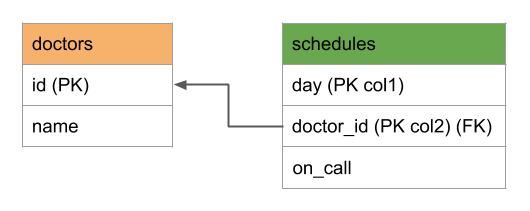
Schema
Step 1. Set up the scenario on PostgreSQL
-
If you haven’t already, install PostgreSQL locally. On Mac, you can use Homebrew:
-
Start PostgreSQL:
-
Open a SQL connection to PostgreSQL:
-
Create the
doctorstable: -
Create the
schedulestable: -
Add two doctors to the
doctorstable: -
Insert one week’s worth of data into the
schedulestable: -
Confirm that at least one doctor is on call each day of the week:
Step 2. Run the scenario on PostgreSQL
-
Doctor 1, Abe, starts to request leave for 10/5/18 using the hospital’s schedule management application. The application starts a transaction:
-
The application checks to make sure at least one other doctor is on call for the requested date:
-
Around the same time, doctor 2, Betty, starts to request leave for the same day using the hospital’s schedule management application. In a new terminal, start a second SQL session:
-
The application starts a transaction:
-
The application checks to make sure at least one other doctor is on call for the requested date:
-
In the terminal for doctor 1, since the previous check confirmed that another doctor is on call for 10/5/18, the application tries to update doctor 1’s schedule:
-
In the terminal for doctor 2, since the previous check confirmed the same thing, the application tries to update doctor 2’s schedule:
-
In the terminal for doctor 1, the application commits the transaction, despite the fact that the previous check (the
SELECTquery) is no longer true: -
In the terminal for doctor 2, the application commits the transaction, despite the fact that the previous check (the
SELECTquery) is no longer true:
Step 3. Check data correctness on PostgreSQL
So what just happened? Each transaction started by reading a value that, before the end of the transaction, became incorrect. Despite that fact, each transaction was allowed to commit. This is known as write skew, and the result is that 0 doctors are scheduled to be on call on 10/5/18. To check this, in either terminal, run:READ COMMITTED, but note that this would happen with any isolation level except SERIALIZABLE and some implementations of REPEATABLE READ:
\q and then stop the PostgreSQL server:
Step 4. Set up the scenario on CockroachDB
When you repeat the scenario on CockroachDB, you’ll see that the anomaly is prevented by CockroachDB’sSERIALIZABLE transaction isolation.
- If you haven’t already, locally.
-
Use the command to start a one-node CockroachDB cluster in insecure mode:
-
In a new terminal window, open the and connect to
localhost: -
Create the
doctorstable: -
Create the
schedulestable: -
Add two doctors to the
doctorstable: -
Insert one week’s worth of data into the
schedulestable: -
Confirm that at least one doctor is on call each day of the week:
Step 5. Run the scenario on CockroachDB
-
Doctor 1, Abe, starts to request leave for 10/5/18 using the hospital’s schedule management application. The application starts a transaction:
-
The application checks to make sure at least one other doctor is on call for the requested date:
Press enter a second time to have the server return the result:
-
Around the same time, doctor 2, Betty, starts to request leave for the same day using the hospital’s schedule management application. In a new terminal, start a second SQL session:
-
The application starts a transaction:
-
The application checks to make sure at least one other doctor is on call for the requested date:
Press enter a second time to have the server return the result:
-
In the terminal for doctor 1, since the previous check confirmed that another doctor is on call for 10/5/18, the application tries to update doctor 1’s schedule:
-
In the terminal for doctor 2, since the previous check confirmed the same thing, the application tries to update doctor 2’s schedule:
-
In the terminal for doctor 1, the application tries to commit the transaction:
Since CockroachDB uses
SERIALIZABLEisolation, the database detects that the previous check (theSELECTquery) is no longer true due to a concurrent transaction. It therefore prevents the transaction from committing, returning a retry error that indicates that the transaction must be attempted again:
-
In the terminal for doctor 2, the application tries to commit the transaction:
Since the transaction for doctor 1 failed, the transaction for doctor 2 can commit without causing any data correctness problems.
Step 6. Check data correctness on CockroachDB
-
In either terminal, confirm that one doctor is still on call for 10/5/18:
-
Again, the write skew anomaly was prevented by CockroachDB using the
SERIALIZABLEisolation level: -
Exit the SQL shell in each terminal:
-
Exit each SQL shell with
\qand then stop the node: Get the process ID of the node:Gracefully shut down the node, specifying its process ID:If you do not plan to restart the cluster, you may want to remove the node’s data store: