

- High availability: Continuously access data without interruption even in the presence of failures or disruptions to maximize uptime.
- Disaster recovery: Recover from a major incident or disaster to minimize downtime and data loss.
Resilience strategy
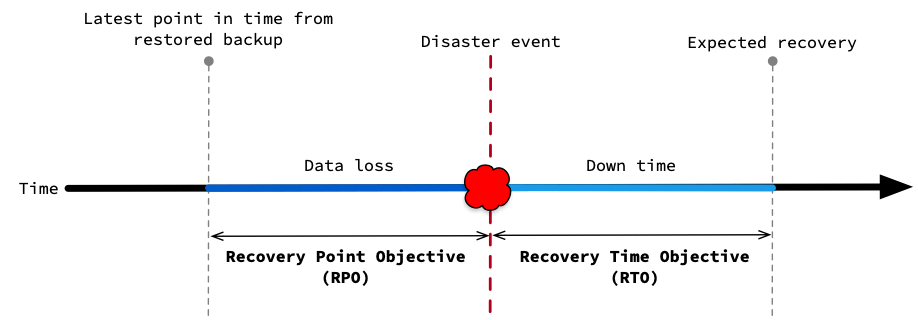
As you evaluate CockroachDB’s disaster recovery features, consider your organization’s requirements for the amount of tolerable data loss and the acceptable length of time to recover.- Recovery Point Objective (RPO): The maximum amount of data loss (measured by time) that an organization can tolerate.
- Recovery Time Objective (RTO): The maximum length of time it should take to restore normal operations following an outage.
Choose a high availability strategy
CockroachDB uses synchronous, built-in replication to create and distribute copies of data, ensuring consistency across the data copies. The database can tolerate nodes going offline without service interruption, whether in a single-region or cluster.
For details on designing your cluster topology for high availability with replication, refer to the page.