

cockroach process on the node.
There are two ways to handle node shutdown:
-
Drain a node to temporarily stop it when you plan restart it later, such as during cluster maintenance. When you drain a node:
- Clients are disconnected, and subsequent connection requests are sent to other nodes.
- The node’s data store is preserved and will be reused as long as the node restarts in a short time. Otherwise, the node’s data is moved to other nodes.
cockroachprocess to perform maintenance, then restart the process for the node to rejoin the cluster. The--shutdownflag of automatically terminates thecockroachprocess after draining completes. A node is also automatically drained when . Draining a node is lightweight because it generates little node-to-node traffic across the cluster. -
Decommission a node to permanently remove it from the cluster, such as when scaling down the cluster or to replace the node due to hardware failure. During decommission:
- The node is drained automatically if you have not manually drained it.
- The node’s data is moved off the node to other nodes. This generates a large amount of node-to-node network traffic, so decommissioning a node is considered a heavyweight operation.
- The details of the node shutdown sequence from the point of view of the
cockroachprocess on a CockroachDB node. - How to prepare for graceful shutdown on CockroachDB self-hosted clusters by coordinating load balancer, client application server, process manager, and cluster settings.
- How to perform node shutdown on CockroachDB self-hosted deployments by manually draining or decommissioning a node.
- How to handle node shutdown when CockroachDB is deployed using Kubernetes or in a CockroachDB Advanced cluster.
- Drain
- Decommission
Node shutdown sequence
When a node is temporarily stopped, the following stages occur in sequence:Draining
An operator initiates the draining process on the node. Draining a node disconnects clients after active queries are completed, and transfers any and to other nodes, but does not move replicas or data off of the node.When draining is complete, the node must be shut down prior to any maintenance. After a 60-second wait at minimum, you can send aSIGTERM signal to the cockroach process to shut it down. The --shutdown flag of automatically terminates the cockroach process after draining completes.After you perform the required maintenance, you can restart the cockroach process on the node for it to rejoin the cluster.Do not terminate the
cockroach process before all of the phases of draining are complete. Otherwise, you may experience latency spikes until the that were on that node have transitioned to other nodes. It is safe to terminate the cockroach process only after a node has completed the drain process. This is especially important in a containerized system, to allow all TCP connections to terminate gracefully. If necessary, adjust the server.shutdown.initial_wait and the cluster settings and adjust your process manager or other deployment tooling to allow adequate time for the node to finish draining before it is terminated or restarted.-
Unready phase: The node’s returns an HTTP
503 Service Unavailableresponse code, which causes load balancers and connection managers to reroute traffic to other nodes. This phase completes when the fixed duration set byserver.shutdown.initial_waitis reached. -
SQL wait phase: New SQL client connections are no longer permitted, and any remaining SQL client connections are allowed to close or time out. This phase completes either when all SQL client connections are closed or the maximum duration set by
server.shutdown.connections.timeoutis reached. -
SQL drain phase: All active transactions and statements for which the node is a are allowed to complete, and CockroachDB closes the SQL client connections immediately afterward. After this phase completes, CockroachDB closes all remaining SQL client connections to the node. This phase completes either when all transactions have been processed or the maximum duration set by
server.shutdown.transactions.timeoutis reached. -
DistSQL drain phase: All initiated on other gateway nodes are allowed to complete, and DistSQL requests from other nodes are no longer accepted. This phase completes either when all transactions have been processed or the maximum duration set by
server.shutdown.transactions.timeoutis reached. -
Lease transfer phase: The node’s field is set to
true, which removes the node as a candidate for replica rebalancing, lease transfers, and query planning. Any or must be transferred to other nodes. This phase completes when all range leases and Raft leaderships have been transferred.
server.shutdown.initial_wait, node draining will stop and must be restarted manually to continue. For more information, see Drain timeout.At this point, it is safe to terminate the cockroach process manually or using your process manager or other deployment tooling (such as Kubernetes, Nomad, or Docker).Process termination
After draining is complete:- If the node was drained automatically because the
cockroachprocess received aSIGTERMsignal, thecockroachprocess is automatically terminated when draining is complete. - If the node was drained manually because an operator issued a
cockroach node draincommand:- If you pass the
--shutdownflag to , thecockroachprocess terminates automatically after draining completes. - If the node’s major version is being updated, the
cockroachprocess terminates automatically after draining completes. - Otherwise, the
cockroachprocess must be terminated manually. A minimum of 60 seconds after draining is complete, send it aSIGTERMsignal to terminate it. Refer to Terminate the node process.
- If you pass the
cockroach process on the node. The node will stop updating its liveness record.If the node then stays offline for the duration set by server.time_until_store_dead (5 minutes by default), the cluster considers the node “dead” and starts to rebalance its range replicas onto other nodes.If the node is brought back online, its remaining range replicas will determine whether or not they are still valid members of replica groups. If a range replica is still valid and any data in its range has changed, it will receive updates from another replica in the group. If a range replica is no longer valid, it will be removed from the node.CockroachDB’s node shutdown behavior does not match any of the PostgreSQL server shutdown modes.
Prepare for graceful shutdown
Each of the node shutdown steps is performed in order, with each step commencing once the previous step has completed. However, because some steps can be interrupted, it’s best to ensure that all steps complete gracefully.Before you perform node shutdown, review the following prerequisites to graceful shutdown:- Configure your load balancer to monitor node health.
- Review and adjust cluster settings and drain timeout as needed for your deployment.
- Configure the termination grace period and if necessary, adjust the configuration of your process manager, orchestration system, or deployment tooling accordingly.
Load balancing
Your should use the to actively monitor node health and direct SQL client connections away from nodes that are not ready to receive requests.To handle node shutdown effectively, the load balancer must be given enough time by theserver.shutdown.initial_wait duration.Cluster settings
server.shutdown.initial_wait
Alias: server.shutdown.drain_waitserver.shutdown.initial_wait sets a fixed duration for the “unready phase” of node drain. Because a load balancer reroutes connections to non-draining nodes within this duration (0s by default), this setting should be coordinated with the load balancer settings.Increase server.shutdown.initial_wait so that your load balancer is able to make adjustments before this phase times out. Because the drain process waits unconditionally for the server.shutdown.initial_wait duration, do not set this value too high.For example, uses the default settings inter 2000 fall 3 when checking server health. This means that HAProxy considers a node to be down (and temporarily removes the server from the pool) after 3 unsuccessful health checks being run at intervals of 2000 milliseconds. To ensure HAProxy can run 3 consecutive checks before timeout, set server.shutdown.initial_wait to 8s or greater:server.shutdown.connections.timeout
Alias: server.shutdown.connection_waitserver.shutdown.connections.timeout sets the maximum duration for the “connection phase” of node drain. SQL client connections are allowed to close or time out within this duration (0s by default). This setting presents an option to gracefully close the connections before CockroachDB forcibly closes those that remain after the “SQL drain phase”.Change this setting only if you cannot tolerate connection errors during node drain and cannot configure the maximum lifetime of SQL client connections, which is usually configurable via a . Depending on your requirements:- Lower the maximum lifetime of a SQL client connection in the pool. This will cause more frequent reconnections. Set
server.shutdown.connections.timeoutabove this value. - If you cannot tolerate more frequent reconnections, do not change the SQL client connection lifetime. Instead, use a longer
server.shutdown.connections.timeout. This will cause a longer draining process.
server.shutdown.transactions.timeout
Alias: server.shutdown.query_waitserver.shutdown.transactions.timeout sets the maximum duration for the “SQL drain phase” and the maximum duration for the “DistSQL drain phase” of node drain. Active local and distributed queries must complete, in turn, within this duration (10s by default).Ensure that server.shutdown.transactions.timeout is greater than:- The longest possible transaction in the workload that is expected to complete successfully.
- The
sql.defaults.idle_in_transaction_session_timeoutcluster setting, which controls the duration a session is permitted to idle in a transaction before the session is terminated (0sby default). - The
sql.defaults.statement_timeoutcluster setting, which controls the duration a query is permitted to run before it is canceled (0sby default).
server.shutdown.transactions.timeout defines the upper bound of the duration, meaning that node drain proceeds to the next phase as soon as the last open transaction completes.Use instead of the
sql.defaults.* . This allows you to set a default value for all users for any that applies during login, making the sql.defaults.* cluster settings redundant.server.shutdown.lease_transfer_iteration.timeout
Alias: server.shutdown.lease_transfer_waitIn the “lease transfer phase” of node drain, the server attempts to transfer all and from the draining node. server.shutdown.lease_transfer_iteration.timeout sets the maximum duration of each iteration of this attempt (5s by default). Because this phase does not exit until all transfers are completed, changing this value affects only the frequency at which drain progress messages are printed.In most cases, the default value is suitable. Do not set server.shutdown.lease_transfer_iteration.timeout to a value lower than 5s. In this case, leases can fail to transfer and node drain will not be able to complete.The sum of
server.shutdown.initial_wait, server.shutdown.connections.timeout, server.shutdown.transactions.timeout times two, and server.shutdown.lease_transfer_iteration.timeout should not be greater than the configured drain timeout.kv.allocator.recovery_store_selector
When a node is dead or decommissioning and all of its range replicas are being up-replicated onto other nodes, this setting controls the algorithm used to select the new node for each range replica. Regardless of the algorithm, a node must satisfy all available constraints for replica placement and survivability to be eligible.Possible values are good (the default) and best. When set to good, a random node is selected from the list of all eligible nodes. When set to best, a node with a low range count is preferred.server.time_until_store_dead
server.time_until_store_dead sets the duration after which a node is considered “dead” and its data is rebalanced to other nodes (5m0s by default). In the node shutdown sequence, this follows process termination.Before temporarily stopping nodes for planned maintenance (e.g., upgrading system software), if you expect any nodes to be offline for longer than 5 minutes, you can prevent the cluster from unnecessarily moving data off the nodes by increasing server.time_until_store_dead to match the estimated maintenance window:During this window, the cluster has reduced ability to tolerate another node failure. Be aware that increasing this value therefore reduces fault tolerance.
Drain timeout
When draining manually withcockroach node drain, all drain phases must be completed within the duration of --drain-wait (10m by default) or the drain will stop. This can be observed with an ERROR: drain timeout message in the terminal output. To continue the drain, re-initiate the command.A very long drain may indicate an anomaly, and you should manually inspect the server to determine what blocks the drain.CockroachDB automatically increases the verbosity of logging when it detects a stall in the range lease transfer stage of node drain. Messages logged during such a stall include the time an attempt occurred, the total duration stalled waiting for the transfer attempt to complete, and the lease that is being transferred.--drain-wait sets the timeout for all draining phases and is not related to the server.shutdown.initial_wait cluster setting, which configures the “unready phase” of draining. The value of --drain-wait should be greater than the sum of server.shutdown.initial_wait, server.shutdown.connections.timeout, server.shutdown.transactions.timeout times two, and server.shutdown.lease_transfer_iteration.timeout.Termination grace period
On production deployments, a process manager or orchestration system can disrupt graceful node shutdown if its termination grace period is too short.Do not terminate thecockroach process before all of the phases of draining are complete. Otherwise, you may experience latency spikes until the that were on that node have transitioned to other nodes. It is safe to terminate the cockroach process only after a node has completed the drain process. This is especially important in a containerized system, to allow all TCP connections to terminate gracefully.If the cockroach process has not terminated at the end of the grace period, a SIGKILL signal is sent to perform a “hard” shutdown that bypasses CockroachDB’s node shutdown logic and forcibly terminates the process.-
When using
systemdto run CockroachDB as a service, set the termination grace period withTimeoutStopSecsetting in the service file. - When using to orchestrate CockroachDB, refer to Decommissioning and draining on Kubernetes.
-
Run
cockroach node drainwith--drain-waitand observe the amount of time it takes node drain to successfully complete. -
In general, we recommend setting the termination grace period to the sum of all
server.shutdown.*settings. If a node requires more time than this to drain successfully, this may indicate a technical issue such as inadequate . - Increasing the termination grace period does not increase the duration of a node shutdown. However, the termination grace period should not be excessively long, as this can mask an underlying hardware or software issue that is causing node shutdown to become “stuck”.
Perform node shutdown
After preparing for graceful shutdown, do the following to temporarily stop a node. This both drains the node and terminates thecockroach process.Drain the node and terminate the node process
If you passed the--shutdown flag to , the cockroach process terminates automatically after draining completes. Otherwise, terminate the cockroach process.Perform maintenance on the node as required, then restart the cockroach process for the node to rejoin the cluster.Cockroach Labs does not recommend terminating the
cockroach process by sending a SIGKILL signal, because it bypasses CockroachDB’s node shutdown logic and degrades the cluster’s health. From the point of view of other cluster nodes, the node will be suddenly unavailable.- If a decommissioning node is forcibly terminated before decommission completes, and the cluster is at risk of if an additional node experiences an outage in the window before up-replication completes.
- If a draining or decommissioning node is forcibly terminated before the operation completes, it can corrupt log files and, in certain edge cases, can result in temporary data unavailability, latency spikes, , , or query timeouts.
-
On production deployments, use the process manager, orchestration system, or other deployment tooling to send
SIGTERMto the process. For example, withsystemd, runsystemctl stop {systemd config filename}. -
If you run CockroachDB in the foreground for local testing, you can use
ctrl-cin the terminal to terminate the process.
Monitor shutdown progress
After you initiate a node shutdown or restart, the node’s progress is regularly logged to the until the operation is complete. The following sections provide additional ways to monitor the operation’s progress.OPS
During node shutdown, progress messages are generated in the . The frequency of these messages is configured with server.shutdown.lease_transfer_iteration.timeout. , the OPS logs output to a cockroach.log file.Node drain progress is reported in unstructured log messages:cockroach node status
Draining status is reflected in the output:is_draining == true indicates that the node is either undergoing or has completed the draining process.stderr
When CockroachDB receives a signal to drain and terminate the node process, this message is printed to stderr:cockroach process has stopped, this message is printed to stderr:Examples
These examples assume that you have already prepared for a graceful node shutdown.Stop and restart a node
To drain and shut down a node that was started in the foreground with :-
Press
ctrl-cin the terminal where the node is running. -
Filter the logs for draining progress messages. , the
OPSlogs output to acockroach.logfile:Theserver drained and shutdown completedmessage indicates that thecockroachprocess has stopped. -
Start the node to have it rejoin the cluster.
Re-run the command that you used to start the node initially. For example:
Drain a node manually
You can use to drain a node separately from decommissioning the node or terminating the node process.-
Run the
cockroach node draincommand, specifying the ID of the node to drain (and optionally a custom drain timeout to allow draining more time to complete). You can optionally pass the--shutdownflag to to automatically terminate thecockroachprocess after draining completes.You will see the draining status print tostderr: -
Filter the logs for shutdown progress messages. , the
OPSlogs output to acockroach.logfile:Thedrain request completed without server shutdownmessage indicates that the node was drained.
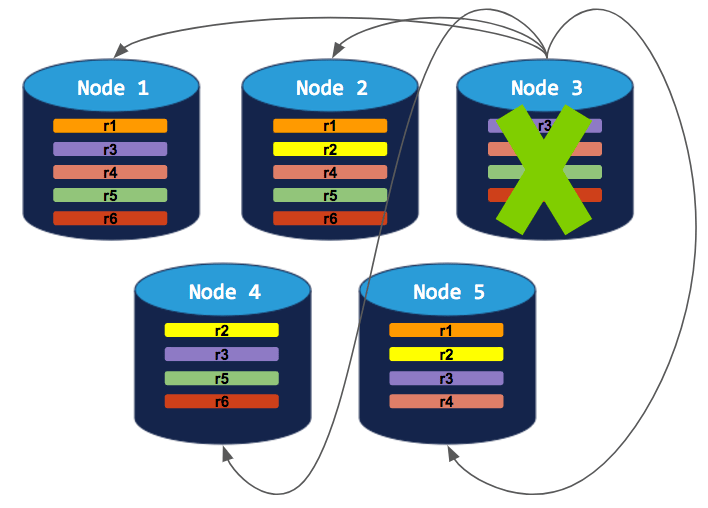
Decommissioning and draining on Kubernetes
Most of the guidance in this page is most relevant to manual deployments that don’t use Kubernetes. If you use Kubernetes to deploy CockroachDB, draining and decommissioning work the same way for thecockroach process, but Kubernetes handles them on your behalf. In a deployment without Kubernetes, an administrator initiates decommissioning or draining directly. In a Kubernetes deployment, an administrator modifies the desired configuration of the Kubernetes cluster and Kubernetes makes the required changes to the cluster, including decommissioning or draining nodes as required.
-
Whether you deployed a cluster using the CockroachDB operator, Helm, or a manual StatefulSet, the resulting deployment is a StatefulSet. Due to the nature of StatefulSets, it’s safe to decommission only the Cockroach node with the highest StatefulSet ordinal in preparation for scaling down the StatefulSet. If you think you need to decommission any other node, consider the following recommendations and contact Support for assistance.
-
If you deployed a cluster using the , the best way to scale down a cluster is to update the specification for the Kubernetes deployment to reduce the value of
nodes:and apply the change using a rolling update. Kubernetes will notice that there are now too many nodes and will reduce them and clean up their storage automatically. - If you deployed the cluster using or a , the best way to scale down a cluster is to interactively decommission and drain the highest-order node. After that node is decommissioned, drained, and terminated, you can repeat the process to further reduce the cluster’s size.
-
If you deployed a cluster using the , the best way to scale down a cluster is to update the specification for the Kubernetes deployment to reduce the value of
-
There is generally no need to interactively drain a node that is not being decommissioned, regardless of how you deployed the cluster in Kubernetes. When you upgrade, downgrade, or change the configuration of a CockroachDB deployment on Kubernetes, you apply the changes using a rolling update, which applies the change to one node at a time. On a given node, Kubernetes sends a
SIGTERMsignal to thecockroachprocess. When thecockroachprocess receives this signal, it starts draining itself. After draining is complete or the termination grace period expires (whichever happens first), Kubernetes terminates thecockroachprocess and then removes the node from the Kubernetes cluster. Kubernetes then applies the updated deployment to the cluster node, restarts thecockroachprocess, and re-joins the cluster. Refer to . -
Although the
kubectl draincommand is used for manual maintenance of Kubernetes clusters, it has little direct relevance to the concept of draining a node in a CockroachDB cluster. Thekubectl draincommand gracefully terminates each pod running on a Kubernetes node so that the node can be shut down (in the case of physical hardware) or deleted (in the case of a virtual machine). For details on this command, see the Kubernetes documentation.
Termination grace period on Kubernetes
After Kubernetes issues a termination request to thecockroach process on a cluster node, it waits for a maximum of the deployment’s terminationGracePeriodSeconds before forcibly terminating the process. If terminationGracePeriodSeconds is too short, the cockroach process may be terminated before it can shut down cleanly and client applications may be disrupted.
If undefined, Kubernetes sets terminationGracePeriodSeconds to 30 seconds. This is too short for the cockroach process to stop gracefully before Kubernetes terminates it forcibly. Do not set terminationGracePeriodSeconds to 0, which prevents Kubernetes from detecting and terminating a stuck pod.
For clusters deployed using the CockroachDB Public operator, terminationGracePeriodSeconds defaults to 300 seconds (5 minutes).
For clusters deployed using the CockroachDB Helm chart or a manual StatefulSet, the default depends upon the values file or manifest you used when you created the cluster.
Cockroach Labs recommends that you:
-
Set
terminationGracePeriodSecondsto no shorter than 300 seconds (5 minutes). This recommendation has been validated over time for many production workloads. In most cases, a value higher than 300 seconds (5 minutes) is not required. If CockroachDB takes longer than 5 minutes to gracefully stop, this may indicate an underlying configuration problem. Test the value you select against representative workloads before rolling out the change to production clusters. -
Set
terminationGracePeriodSecondsto be at least 5 seconds longer than the configured drain timeout, to allow the node to complete draining before Kubernetes removes the Kubernetes pod for the CockroachDB node. -
Ensure that the sum of the following
server.shutdown.*settings for the CockroachDB cluster do not exceed the deployment’sterminationGracePeriodSeconds, to reduce the likelihood that a node must be terminated forcibly.-
server.shutdown.initial_wait -
server.shutdown.connections.timeout -
server.shutdown.transactions.timeouttimes two -
server.shutdown.lease_transfer_iteration.timeoutFor more information about these settings, refer to Cluster settings. Refer also to the Kubernetes documentation about pod termination.
server.shutdown.connections.timeoutsetting. -
Decommissioning and draining on CockroachDB Advanced
Most of the guidance in this page is most relevant to manual deployments, although decommissioning and draining work the same way behind the scenes in a CockroachDB Advanced cluster. CockroachDB Advanced clusters are deployed with the server.shutdown.connections.timeout setting at its default value of0s, and have a termination grace period that is slightly longer than 30 minutes. This grace period is not configurable.
You can adjust the server.shutdown.connections.timeout setting for client applications or application servers that connect to CockroachDB Advanced clusters. Ensure that the connection pool maximum lifetime is shorter than that value, as per the Cluster settings guidance.
Known limitations
-
There is no guaranteed state switch from
DECOMMISSIONINGtoDECOMMISSIONEDif is interrupted in one of the following ways:- The
cockroach node decommission --wait-allcommand was run and then interrupted - The
cockroach node decommission --wait=nonecommand was run
--wait=noneis used, the state will only flip to “decommissioned” when the CLI program is run again after decommissioning has done all its work. - The