

EXECUTION LOCALITY option allows you to restrict the nodes that can execute a job by using a when you create the backup. This will pin the and the nodes that to the defined locality filter.
Pass the WITH EXECUTION LOCALITY option for to restrict execution of the job to nodes with matching localities.
Defining an execution locality for a backup job is useful in the following cases:
- When nodes in a cluster operate in different locality tiers, networking rules can restrict nodes from accessing a storage bucket. For an example, refer to Access backup storage restricted by network rules.
- When a multi-region cluster is running heavy workloads and an aggressive backup schedule, designating a region as the “backup” locality may improve latency. For an example, refer to Create a non-primary region for backup jobs.
CockroachDB also supports locality-aware backups, which allow you to partition and store backup data in a way that is optimized for locality. In general, when you run a locality-aware backup, nodes write backup data to the bucket that is closest to the node locality configured at . Refer to for more detail.
Technical overview
For a technical overview of how a locality-restricted backup works, refer to .Supported products
The feature described on this page is available in CockroachDB Basic, CockroachDB Standard, CockroachDB Advanced, and CockroachDB self-hosted clusters when you are running . For a full list of features, refer to .Syntax
To specify the locality filter for the coordinating node, runEXECUTION LOCALITY with key-value pairs. The key-value pairs correspond to the a node is configured to use when it starts.
You can bind any ordered list of locality key-value pairs, from most inclusive to least inclusive, to a node at startup. For example, a user with a multi-region and multi-cloud deployment may bind each node with cloud=,region= locality tiers. To back up to a specific cloud,region, add cloud={cloud},region={region} as the execution locality arguments:
EXECUTION LOCALITY, consider the following:
- The backup or restore job will fail if no nodes match the locality filter.
- The backup or restore job may take slightly more time to start, because it must select the node that coordinates the backup or restore (the coordinating node). Refer to .
- Even after a backup or restore job has been pinned to a locality filter, it may still read data from another locality if no replicas of the data are available in the locality specified by the backup job’s locality filter.
- If the job is created on a node that does not match the locality filter, you will receive an error even when the job creation was successful. This error indicates that the job execution moved to another node. To avoid this error when creating a manual job (as opposed to a ), you can use the option with
EXECUTION LOCALITY. Then, use the statement to determine when the job has finished. For more details, refer to . - The backup job will send to the cloud storage bucket matching the node’s locality. However, a range’s locality will not necessarily match the node’s locality. The backup job will attempt to back up ranges through nodes matching that range’s locality, however this is not always possible.
Examples
This section outlines some example uses of theEXECUTION LOCALITY option.
Access backup storage restricted by network rules
For security or other reasons, a cluster may be subject to network rules across regions or to other locality requirements. For example, if you have a requirement that only nodes within the same region as the backup location can access the storage bucket, you can configure the backup job’sEXECUTION LOCALITY to execute only on nodes with network access to the bucket.
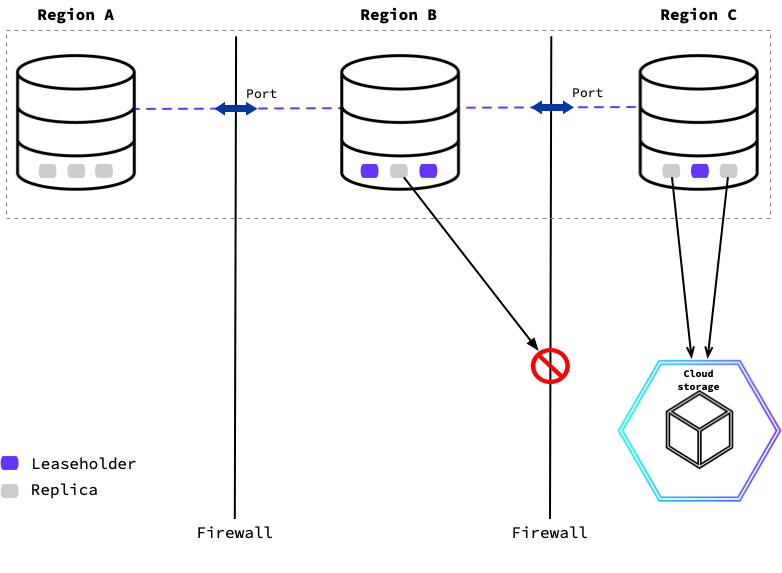
The following diagram shows a CockroachDB cluster where each of the nodes can communicate with each other through a specific port, but any other network traffic between regions is blocked. Replicas in regions that do not match the cloud storage region (Node 2) cannot access the storage to .
Instead, Node 3’s locality does match the backup job’s EXECUTION LOCALITY. Replicas that match a backup job’s locality designation and hold the backup job’s row data will begin reading and exporting to cloud storage.
us-west-1:
Create a non-primary region for backup jobs
Sometimes the execution of backup jobs can consume considerable resources when running . One approach to minimize the impact of running background jobs on foreground application traffic is to restrict the execution of backup jobs to a designated subset of nodes that are not also serving application traffic. This diagram shows a CockroachDB cluster in four regions. The node used to run the backup job was configured with to provide low-latency reads. The node in this region will complete the backup job coordination and data export to cloud storage.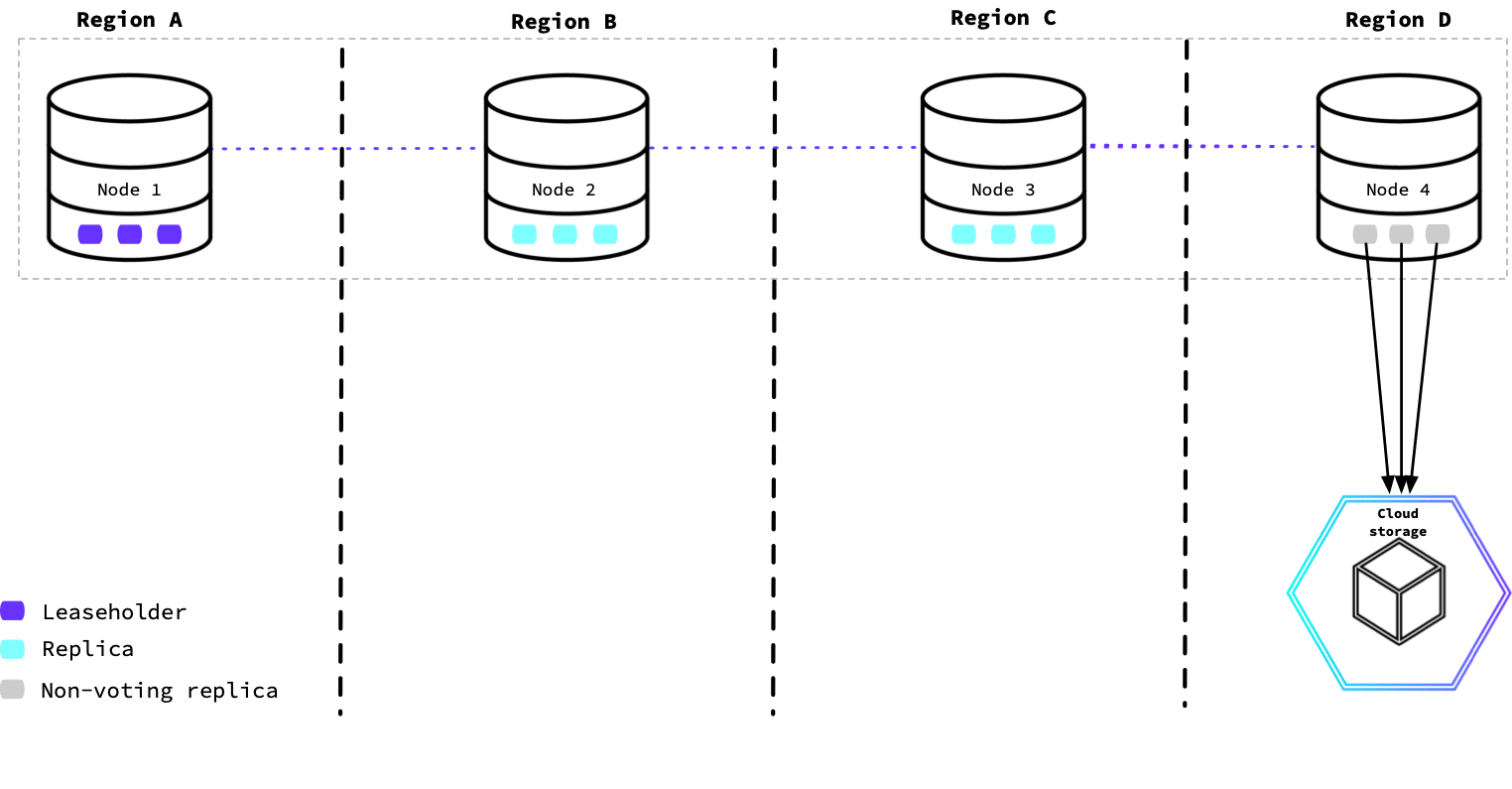
- The flag to specify the locality tiers that describe the location of a node.
- The
num_votersandvoter_constraintsvariables on the page to configure non-voting replicas via zone configurations.