

- The system virtual cluster manages the cluster’s control plane and the replication of the cluster’s data. Admins connect to the system virtual cluster to configure and manage the underlying CockroachDB cluster, set up PCR, create and manage a virtual cluster, and observe metrics and logs for the CockroachDB cluster and each virtual cluster.
- The application virtual cluster manages the cluster’s data plane. Application virtual clusters contain user data and run application workloads.
Replication stream start-up sequence
stream consists of two jobs: one each on the standby and primary cluster:- Standby consumer job: Communicates with the primary cluster via an ordinary SQL connection and is responsible for initiating the replication stream. The consumer job ingests updates from the primary cluster producer job.
- Primary producer job: Protects data on the primary cluster and sends updates to the standby cluster.
- The standby’s consumer job connects to the primary cluster via the standby’s system virtual cluster and starts the primary cluster’s
REPLICATION STREAM PRODUCERjob. - The primary cluster chooses a timestamp at which to start the physical replication stream. Data on the primary is protected from until it is replicated to the standby using a .
- The primary cluster returns the timestamp and a for the replication job.
- The standby cluster retrieves a list of all nodes in the primary cluster. It uses this list to distribute work across all nodes in the standby cluster.
- The initial scan runs on the primary and backfills all data from the primary virtual cluster as of the starting timestamp of the replication stream.
- Once the initial scan is complete, the primary then begins streaming all changes from the point of the starting timestamp.
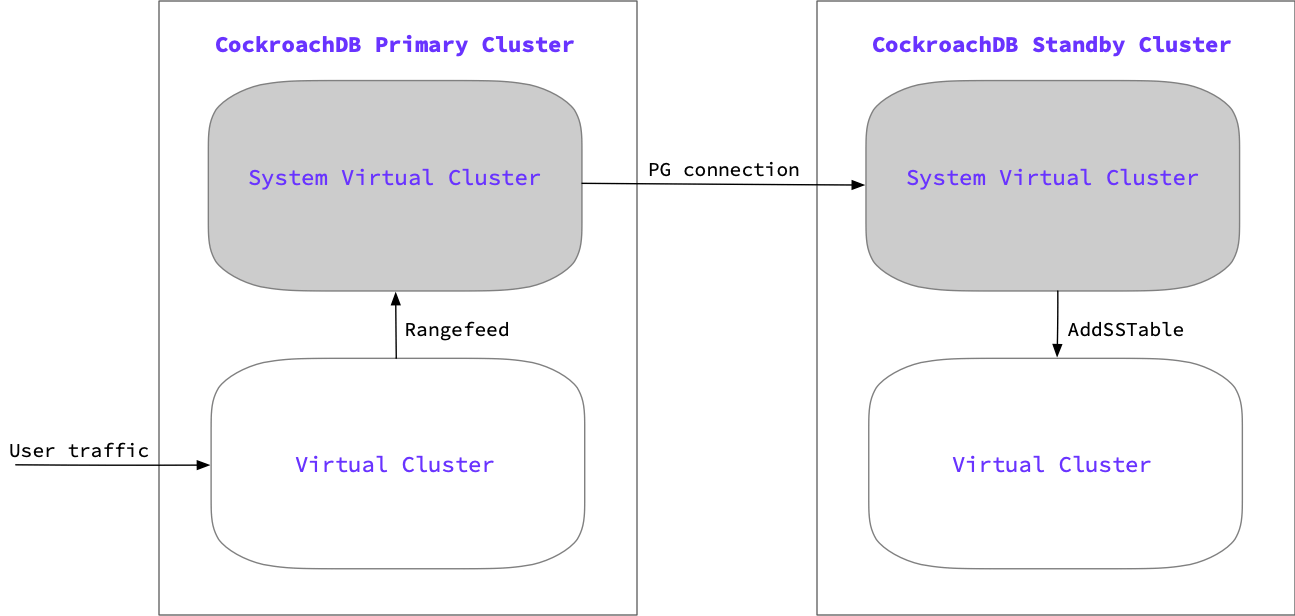
During the replication stream
The replication happens at the byte level, which means that the job is unaware of databases, tables, row boundaries, and so on. However, when a failover to the standby cluster is initiated, the replication job ensures that the cluster is in a transactionally consistent state as of a certain point in time. Beyond the application data, the job will also replicate users, privileges, basic zone configuration, and schema changes. During the job, are periodically emitting resolved timestamps, which is the time where the ingested data is known to be consistent. Resolved timestamps provide a guarantee that there are no new writes from before that timestamp. This allows the standby cluster to move the forward as the replicated timestamp advances. This information is sent to the primary cluster, which allows for to continue as the replication stream on the standby cluster advances.If the primary cluster does not receive replicated time information from the standby after 24 hours, it cancels the replication job. This ensures that an inactive replication job will not prevent garbage collection.
Failover and promotion process
The tracked replicated time and the advancing protected timestamp allow the replication stream to also track retained time, which is a timestamp in the past indicating the lower bound that the replication stream could fail over to. The retained time can be up to 4 hours in the past, due to the protected timestamp. Therefore, the failover window for a replication job falls between the retained time and the replicated time.
For detail on failing back to the primary cluster following a failover, refer to .